Passage — Part III: The Network
‹ Part II — The Arrangement · Contents
Part III — The Network
25 — The Network
The space between the kitchen and the service corridor was narrow, but wide enough for a person to pass through without stopping. Doors opened and closed at regular intervals; everything had been designed to function without effort.
Betty stood aside and watched the flow fold back into itself.
The movement remained the same, but the system was no longer stable. Each passage produced a slight displacement that could not quite be restored.
The kitchen worker appeared again with the same crate.
This time he did not look away.
Their eyes met for an instant, not in recognition but in acknowledgement: each knew the other had understood the relation between them.
He paused without breaking his movement, then continued.
He was working for a system of movement.
Betty did not follow him. There was no need. Catching him was no longer the point.
The point was that the system could no longer be left without consequences.
Betty was already in the director’s office when Justine opened the door without knocking. She did not wait to be invited in.
“You have someone who passes through.”
Betty looked up.
“We have someone who doesn’t leave.”
The distinction between the two sentences was clear now.
Justine came to the table but remained standing, her hands resting on its edge as though testing a boundary.
“That isn’t the same thing.”
“It is,” Betty said. “If he stays inside.”
The silence that followed was not empty.
A police radio crackled briefly from someone’s belt.
The voice was low but clear.
“We’ve got him.”
No one moved at once.
26 — Interrogation
The director’s office had become an interrogation room.
The kitchen worker sat at the table with his hands flat before him. There was no need to restrain him. His presence required no confirmation; within the hotel, he seemed less like a person than a function.
The inspector began without preamble.
“Name.”
The man remained silent, not in defiance but as though the question required nothing from him.
The plainclothes man watched without taking notes, as though trying to catch what was not being said.
“You work in the kitchen?”
“I work where I’m needed.”
The answer was accurate, but insufficient.
“Who brought you in?”
“I came in.”
The conversation went nowhere, yet changed shape with every answer. Each question opened another crack.
Betty stood against the wall, not as an observer but as someone who could see where the difference appeared.
“You saw the body.”
“Yes.”
“When?”
“When I was supposed to.”
The inspector placed a photograph on the table.
“Who brought him in?”
There was a pause.
“He wasn’t brought in.”
The first deviation.
“Moved,” the man said without prompting.
Betty came closer. She was not looking at his face. She was looking at his hands. The trace was there.
“You held the object.”
“No.”
“Your hands say otherwise.”
“It wasn’t mine.”
The silence in the room changed.
“Whose was it?”
“Whoever had it.”
For the first time, another person entered his story.
Not a name. Not a face. A presence.
“Who decides?” the plainclothes man asked.
Silence. Betty answered for him.
“The one who came.”
The man shook his head.
“He doesn’t come.”
“He was in the room,” Betty insisted.
“He was in the space.”
They were talking about different things.
“And he wants the object.”
The man hesitated.
“It isn’t for him.”
That changed the direction of the room.
“Then who is it for?”
“For what is missing.”
Betty looked at him.
“The hand with the bird.”
He neither confirmed nor denied it. He did not need to.
The inspector looked down at the photograph, then at the table, already thinking in the language of reports and closure.
Attention shifted for no more than a moment.
The kitchen worker stood.
Not suddenly. Almost naturally, as though standing were simply the next movement in a sequence already under way.
No one stopped him at first because it did not look like an escape.
It looked like an error.
By the time the officer moved, the door was open.
“Stop!”
The command had nowhere to land.
The man was not running. He did not need to.
He reached the corridor and vanished beyond the point where sight could hold him.
Betty looked towards the door, then upward.
“Not through the corridor,” she said. “Up.”
27 — Movement
They did not move at once. There was no need.
The movement was already there.
They left the passage without hurrying, as though nothing had changed. The corridor remained the same. Only the flow was different.
“Up,” Betty said.
No one asked why.
The stairs were narrow and absorbed their footsteps.
On the roof, the wind changed direction before anyone noticed.
The man was not trying to escape.
He stood near the edge, carrying an object he no longer held, its presence visible only in the tension remaining in his hands.
“You’re carrying it,” Betty said.
“It isn’t with me.”
She looked at his hands.
“It is.”
Justine approached without haste. She did not need to stop him.
There was no resistance.
“Where is it?”
The silence carried its own answer.
“You already passed it on,” Betty said.
A brief pause.
“I didn’t.”
“You did.”
The wind crossed the roof and shifted the silence.
“To whom?” Justine asked.
“To him. The one who passes through everything and is nowhere.”
That was the real answer.
28 — Break
On the roof, the man’s movement did not resemble escape. It looked like the completion of a route already determined.
He was not trying to get away because there was nowhere to return to. The movement had a direction, but no exit.
He stood near the edge, at a distance from which returning no longer seemed possible.
“You’re carrying it,” Sofi said.
“It isn’t with me.”
She looked at his hands. The object was gone. Its imprint remained.
“It is.”
Justine reached him without sudden movement and stopped him without force. Resistance was no longer possible.
“Where is it?”
The silence carried its own answer.
“You already gave it away,” Sofi said.
“I didn’t.”
“You did.”
The silence lasted longer this time.
“To whom?” Justine asked.
“To the one who doesn’t carry it.”
That was an answer. At that moment, something slipped. Not from his hands. From the movement itself.
It skidded towards the edge of the roof and stopped against the gutter, almost balanced between falling into nothingness and remaining.
Sofi-Betty reached it first.
She did not pick it up immediately. She looked at the way it lay, as though even now it had nowhere it belonged.
Then she lifted it very carefully. Its shape needed no name. The metal wing of a bird. The missing fragment.
Everything absent from it could be imagined precisely. That was why it could be joined to the whole.
She held it for a moment, then placed it on the flat surface of the roof.
Justine came closer but did not touch it.
“That’s it.”
It did not sound like a conclusion.
More like a closure imposing itself.
Only then did the officer approach. He picked it up slowly but precisely, as though he already knew it was not a whole.
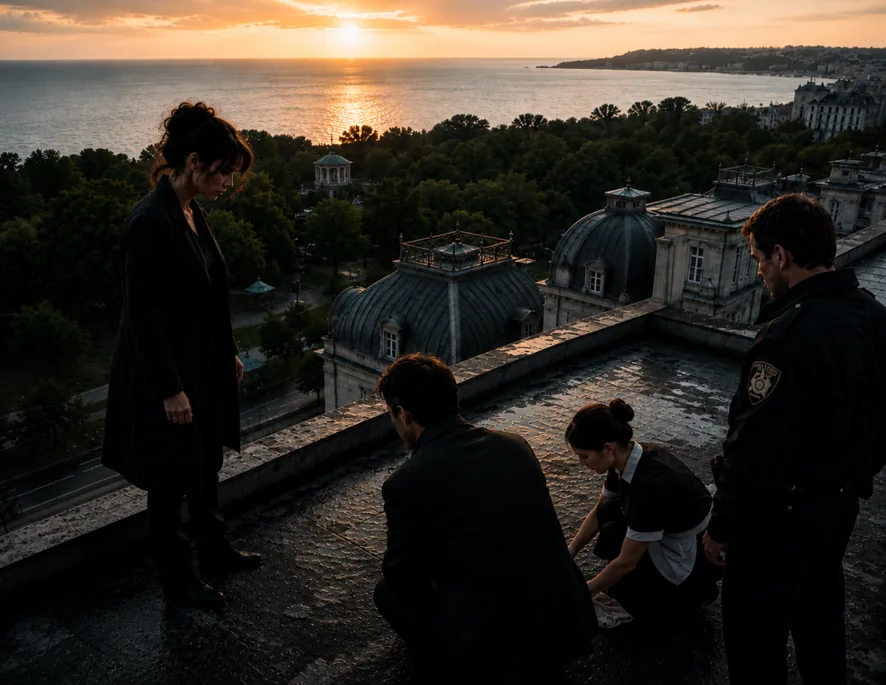
“Evidence.”
No one answered. The transformation had already happened.
Sofi-Betty no longer looked at the object. She looked at what held it. The wing had, in a sense, been found in mid-air.
The kitchen worker did not try to explain. He had nothing to explain.
Everything was over.
They went downstairs. The corridor looked unchanged, but what they had been searching for was no longer moving through it.
The wing was in police custody now.
It had a place. It had become evidence.
29 — The Bistro
They had been seeing each other in the garden for some time, between the fountain and the staff entrance, without ever needing to acknowledge it.
Flobjan made his arrangements by disturbing perfection. He left lines open, forms slightly unresolved, as though completion itself would destroy what held them together.
“Perfection retains nothing,” he had once said.
It applied beyond the garden.
Police officers were already stationed at reception. They were no longer asking questions.
“Come out of this atmosphere for a while,” Flobjan said. “You’re tense, pale, exhausted. Have a drink with me. Get some distance. Come back to yourself.”
Now they were sitting in a nearby bistro.
Betty felt better almost immediately. Warmth moved through her body and the rigidity of the past hours began to loosen.
Between them was the kind of agreement that required no declaration. There were no questions demanding precise answers, only a silence in which nothing had to be explained.
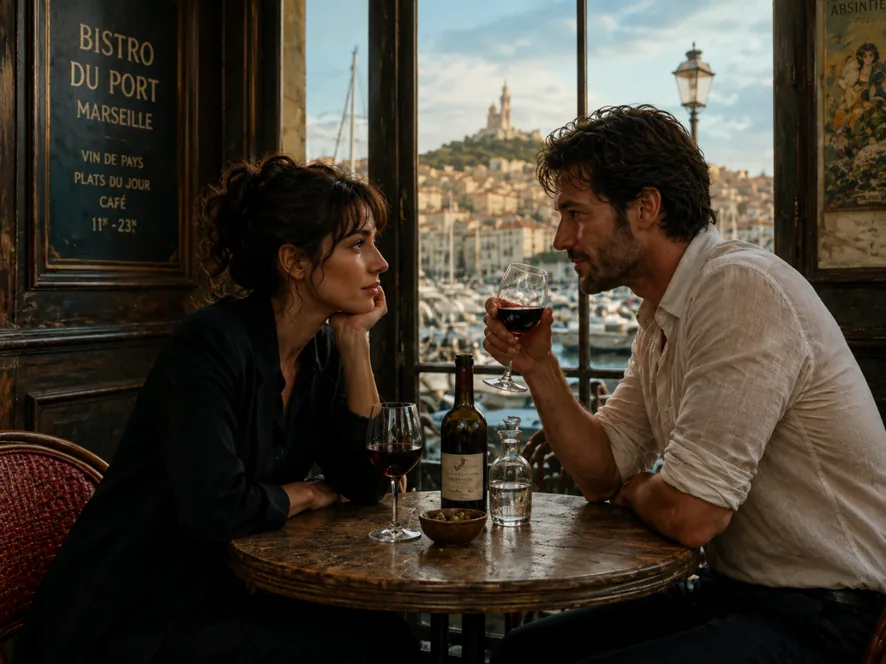
“It isn’t over,” Flobjan said.
“I know.”
He looked at her without asking her to confirm what he could already see.
“You’re not going to stay inside it.”
It was not a question.
Betty lowered her eyes to the rim of her glass, where a brief reflection appeared and vanished. She thought of his hands: soil beneath the nails, the scent of plants lingering longer than touch, the way he handled things without possessing them.
“What is your name, Betty?”
She looked at him.
“Sofi. Sofi de Montreuil.”
Her real name settled between them without ceremony, changing their relationship before it had found a place.
30 — The Discovery
Justine arrived earlier than usual and went directly to the sixth floor.
Two uniformed officers followed her, then the hotel director and the manager. Madame Tanja was already there. She asked nothing. The Marseille public prosecutor arrived last, visibly displeased that an investigation of this scale had developed in his jurisdiction without his control.
Betty was waiting in the corridor.
“Now?” Justine asked.
“Now.”
They stopped before the line, at the place where the wall was not a wall.
Justine pressed the point she already knew.
The panel moved.
It did not look like a door opening.
More like a surface withdrawing from its role.
Behind it was a corridor.
Narrow, unmarked, lit by no light belonging to the sixth floor.
For a moment, no one stepped inside.
Then Justine entered. Betty followed. Madame Tanja came last.
The passage had not been designed for comfortable movement. Its walls were scarred at the edges, the floor worn. Everything suggested frequent, discreet use.
“This isn’t part of the hotel,” one of the officers said.
“It is,” Betty replied. “Just not the part intended for guests.”
They moved slowly. The corridor curved gently, preventing them from seeing its end.
Halfway along it, Betty stopped at a recess in the wall. Inside stood a large basket lined with quilted padding. Above it was an opening through which air moved from somewhere beyond the passage.
And much more than air.
“Here,” Betty said.
No one asked what entered there.
At the end of the corridor they found a room.
Small, windowless, functional.
At its centre stood a steel table, its surface almost surgical in its cleanliness.
One of the officers approached.
“Here…”
He stopped.
“He was here.”
Justine studied the room.
“He wasn’t killed here.”
“How do you know?”
“This was a place of passage, not a place of death.”
Betty approached the table.
“He was a courier.”
“For what?”
“For things that cannot be declared.”
“Was he killed, or was it an accident?” the officer asked.
Betty did not answer. Justine did.
“A chain of bad circumstances.”
One of the officers looked around.
“This goes further.”
Behind the table, more fine lines appeared in the wall.
Panels. Several of them. They were not identical.
They did not all lead to the same place.
Justine pressed one. Nothing happened.
“How many?”
No one from the hotel answered. Betty looked back along the passage.
“Enough.”
An officer found a door disguised as another section of wall.
Behind it was a smaller room covered with plans.
Not one plan of the hotel, but many.
Old drawings lay beneath newer ones, layers of architecture accumulating across decades: corridors extended, blocked, redirected; rooms added and divided; walls moved while their previous positions survived underneath.
In some places the drawings corresponded to the hotel above them.
In others, they did not.
There were passages that had vanished from the official plans of the repeatedly rebuilt and extended hotel but not from the building itself.
Corridors leading nowhere. Or beyond the map.
“This has been here a long time,” one of the officers said.
“It was never finished,” Justine said. “It wasn’t meant to be.”
Betty looked at the plans differently. Not as documents. As routes.
“Entrances and exits without visibility.”
Justine said the word aloud.
“Smuggling.”
The word hovered in the room. It explained everything and nothing.
“What actually happened here?” another officer asked. “And how long has this been going on?”
No one answered.
Betty looked at the steel table, then towards the passage through which they had entered.
“It couldn’t hold any longer.”
Justine nodded.
That was as close as they could come to an explanation without pretending they had solved everything.
“Where do the exits we couldn’t open lead?” the Marseille prosecutor asked.
“Probably beyond the hotel,” Justine said. “Some of them towards the port.”
Nothing on the sixth floor was visibly broken.
But nothing responded immediately anymore.
The door to 608 opened only on the second attempt. Key cards hesitated for a fraction of a second, as though the hotel had begun to question who was entitled to pass.
The staff lift stalled between the fifth and sixth floors. Phone signals vanished precisely where the corridor changed width.
One chambermaid turned the wrong way and opened a service door she had never used before.
“Sorry,” she said into the empty space, then stood there bewildered, as though unsure why she had turned at all — and why she had apologised when no one was there.
For the first time, Betty thought the hotel itself was no longer remaining the same.
31 — The Whole
The lounge had been arranged for closure.
Chairs aligned, intervals measured, light even, doors shut. Police stood along the wall, the prosecutor by the window, the director and manager near the table. Madame Tanja occupied a place belonging to neither side. Justine stood between them with a notebook she never opened.
Everyone was where they were supposed to be.
That was why it could end.
At the centre of the table, on the clean surface, lay the wing.
Not displayed. Not concealed. Placed. A part waiting to be returned.
No one touched it. There was no need. Everyone already knew where it belonged, although no one could show the whole.
Justine looked up.
“We have the missing piece.”
No one answered. There was nothing to add.
The director looked from the wing to Justine, as though checking the order in which the next steps were supposed to occur.
“The object enters procedure,” he said. “It will be entered into evidence.”
The wording was precise.
It meant there was a place for it.
The manager nodded.
An officer stepped towards the table and waited for the signal to take it.
Everything was ready.
Betty stood apart, without a place that belonged to her.
She was looking at the arrangement, not at the people.
For the first time, she did not know whether what she saw should be preserved or removed.
Then she moved.
Without asking permission, without disturbing the rhythm, she went to the table and picked up the wing.
For a moment, no one reacted.
She turned it in her hands, examining the surface with her fingertips almost tenderly, lingering over the joint where metal had once met the hand.
“That is evidence,” the prosecutor warned.
He was looking not at Betty, but at the empty place on the table, as though the object should still have been there.
“It is a fragment,” the director said.
“It can be returned,” someone added.
The sentences came easily.
They closed what was already prepared to be closed.
Betty kept the wing in her hand, feeling especially the joint where it had met the hand. Beneath her fingers were the irregularities left by time, the minute damage invisible while the whole could still stand upright.
No one in the room moved.
Her breathing suddenly became audible, deep, as though she had been running. Her eyes burned.
For a moment, the wing remained suspended between the table and her body, an object still waiting for a decision.
Then she raised it and brought it down against the edge of the table.
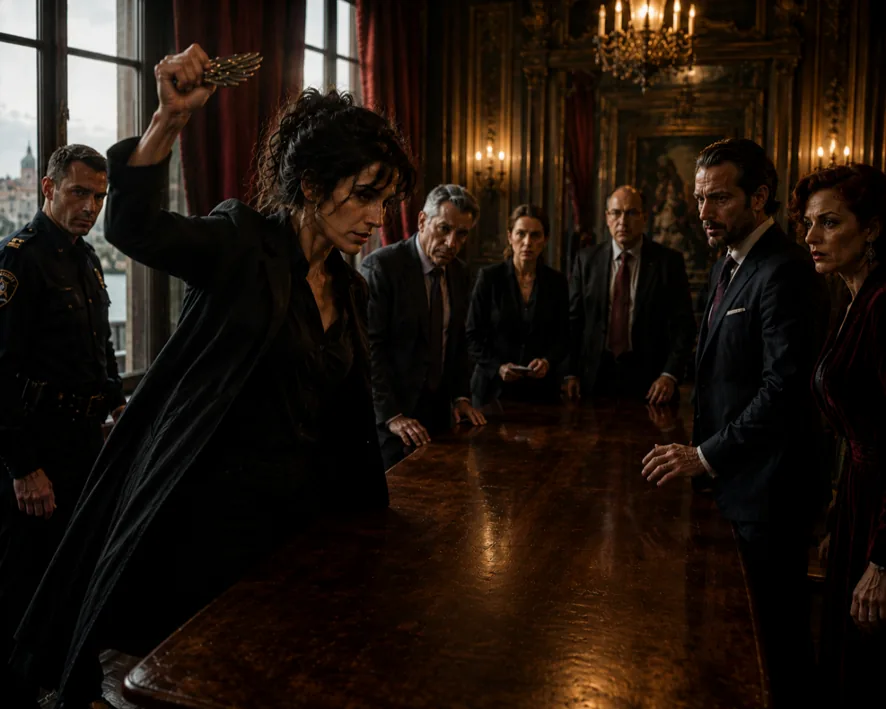
The sound was surprisingly small. A brief resistance giving way. A line opened. Not suddenly.
As though what had already been divided were simply separating again.
Two pieces remained in her hands. She did not put them down immediately.
The officer stopped midway towards her, his hand suspended in the air without an object to take.
The prosecutor stepped forward, then stopped. The director did not look away.
The manager tried to speak, but no word fit.
Justine did not write. She watched her sister.
There was no longer a place on the table for what was supposed to be returned. The two pieces could no longer be joined. The whole no longer existed.
Betty placed them on the table, apart from one another.
She left no possibility of restoring them to the same relation.
The distance between them was small. Enough. Everything else remained in place. The table.
The light. The people.
“Why?” Justine asked.
Not a question about the act itself.
A question about the reason beneath it.
Betty looked at the table, then at the lines left without a whole.
“To see whether it could be interrupted.”
No one reacted. There was no room for reaction.
“And?”
This time Betty raised her eyes to all of them.
Not as a witness.
As someone who had made a decision larger than herself.
“It can be broken.”
A fact. Nothing in the lounge changed.
The chairs remained aligned. The intervals remained the same.
But the procedure could no longer continue as intended. Not because the evidence was gone, but because the whole on which its meaning depended no longer existed.
The prosecutor closed the file, though not completely.
The officer lowered his hand. The director remained where he was. The manager did not look away. Madame Tanja gave no reaction.
Justine closed her notebook. Betty turned and left.
At the instant the wing broke, the staff lift stopped between floors.
The lights throughout the hotel flickered once. The internet signal vanished. Several guests later complained of a brief loss of orientation.
In the garden, Flobjan stood before an arrangement that could no longer be what it had been.
Betty walked towards the main entrance and stopped.
For the first time, she could no longer tell where the guest corridor ended and the service passage began.
32 — The Encounter
He did not approach her immediately.
Flobjan stood at the far end of the corridor.
Sofi saw him before he began walking towards her, and a smile lit her face. That alone was an enormous change.
He came without hurry, light falling over him too, and stopped at a distance that was not accidental.
“I know,” he said.
Not a question. Not a conclusion.
More like a place they had both already reached.
He glanced towards the sixth floor, then back at her.
“You did what no one here even tried to do.”
The sentence required no confirmation.
Sofi said nothing. There was nothing to add to what was already visible.
Flobjan lowered his eyes for a moment, as though for the first time searching for words that did not belong to their old relationship, then looked at her again.
“I’m proud of you.”
Everything was in that sentence.
Sofi kept her eyes on him, not beyond him. She noticed his sleeves pushed above his forearms, the slow movement of his hand as he shifted his weight, a tension that no longer belonged only to work. His voice was deeper than before, free of the hotel’s control.
“Come to lunch with me. Now.”
No preamble. No justification.
“There’s a place,” he said. “It overlooks the sea.”
For the first time Sofi lowered her eyes, not to avoid him, but to hold on to what had just shifted inside her.
Then she looked at him again.
His lips were slightly damp, his voice steady, effortless.
“Now?”
“Now. Yes. Right now.”
She nodded without checking the time, without thinking of obligations.
None of that was necessary anymore.
They walked down the corridor together, neither ahead nor behind, their pace falling naturally into step.
At the exit she stopped briefly, out of habit, and looked back at the hotel — no longer as a system, but as a place.
Then at him.
“Where?”
Flobjan smiled without reserve.
“The most beautiful place in Marseille.”
He said it not as a promise, but as a fact.
They stepped outside.
This time she had no need to know where anything belonged.
The hotel remained behind her, asking nothing.
The light outside did not alter the arrangement of things.
It altered the way she saw them.
Sofi no longer looked at things to discover where they did not belong.
She looked at him — his hands, the line of his neck, and lips now closer than the door between two rooms had ever been.
Record
There was no public announcement.
The official record stated that the case had been closed for lack of evidence.
Formally, it was over. Sofi knew what that meant. She had not closed it. She had not restored anything.
She had interrupted it. It was not victory.
It was the feeling of being free within herself.
Nothing in the hotel changed from the outside. Corridors kept their direction, doors their numbers, everything remained in its place.
Only the hotel no longer decided in quite the same way.
Several months later, the sixth floor was renumbered on the hotel’s internal plan.
No reason was ever given.
During the renovation that followed, the passage between 601 and 602 was sealed.
The thickness of the new wall did not correspond to the original plans of the building.
Sofi-Betty remained at the hotel. Betty, when she needed to see. Sofi, when she was free to choose.
Between the two, she was no longer divided.
She was in her place.
For the first time, she did not check where things belonged.
She moved on. Not out of the hotel. Through it. Towards what had not happened yet.

