Passage — Part II: The Arrangement
‹ Part I — The Hotel · Contents · Part III — The Network ›
Part II — The Arrangement
17 — The Body
The body found in 602 acquired a name before it acquired meaning.
A middle-aged man, according to the documents in 601. Passport, bank cards, a business card bearing an unmemorable name and the name of a company that existed only on paper. Everything in order, no gaps, no excess, as though the identity had been prepared in advance and left in 601 while the body was placed elsewhere later.
There was no woman in the records.
Only information with nowhere to belong.
“We have an identity,” the inspector said in the lounge, holding the file as though he were closing the case.
The plainclothes man did not answer at once. He looked at the photograph not as evidence, but as a surface that had to withstand scrutiny.
“Too fast.”
“It matches.”
“Everything matches.”
That was precisely the problem.
“How much is it worth?”
The question did not belong to the conversation.
No one answered immediately. The inspector looked up. The plainclothes man did not repeat it.
Betty stood near the door. She had not been invited in, but neither had she been sent away. She could see enough and still did not belong to the conversation.
“Name?”
The inspector looked at her.
“You’re not part of this.”
“I know. But I can hear you.”
He did not send her away.
“Arnaud Delmas.”
The name entered the room without resistance. Nothing changed.
Betty looked at the file. The photograph was neither recent nor old. A calm, closed face, without any feature that insisted on being remembered. A face made to pass.
“That isn’t him.”
The inspector gave a short, professional sigh.
“Excuse me?”
“That isn’t him.”
“Based on what?”
“On what he is.”
Not an answer that belonged in a report.
The plainclothes man looked at her.
“Explain.”
Betty moved closer, though not to the file. She looked at the table: folder, pen, phone, untouched glass of water. Everything orderly. Nothing alive.
“That is an identity that fits,” she said. “Not one that belongs.”
“What’s the difference?”
“A large one.”
“To whom?”
“To the person using it.”
There was a pause.
The inspector opened the file and removed the passport. Flawless paper, clean edges, a photograph corresponding perfectly to the face in the bathtub.
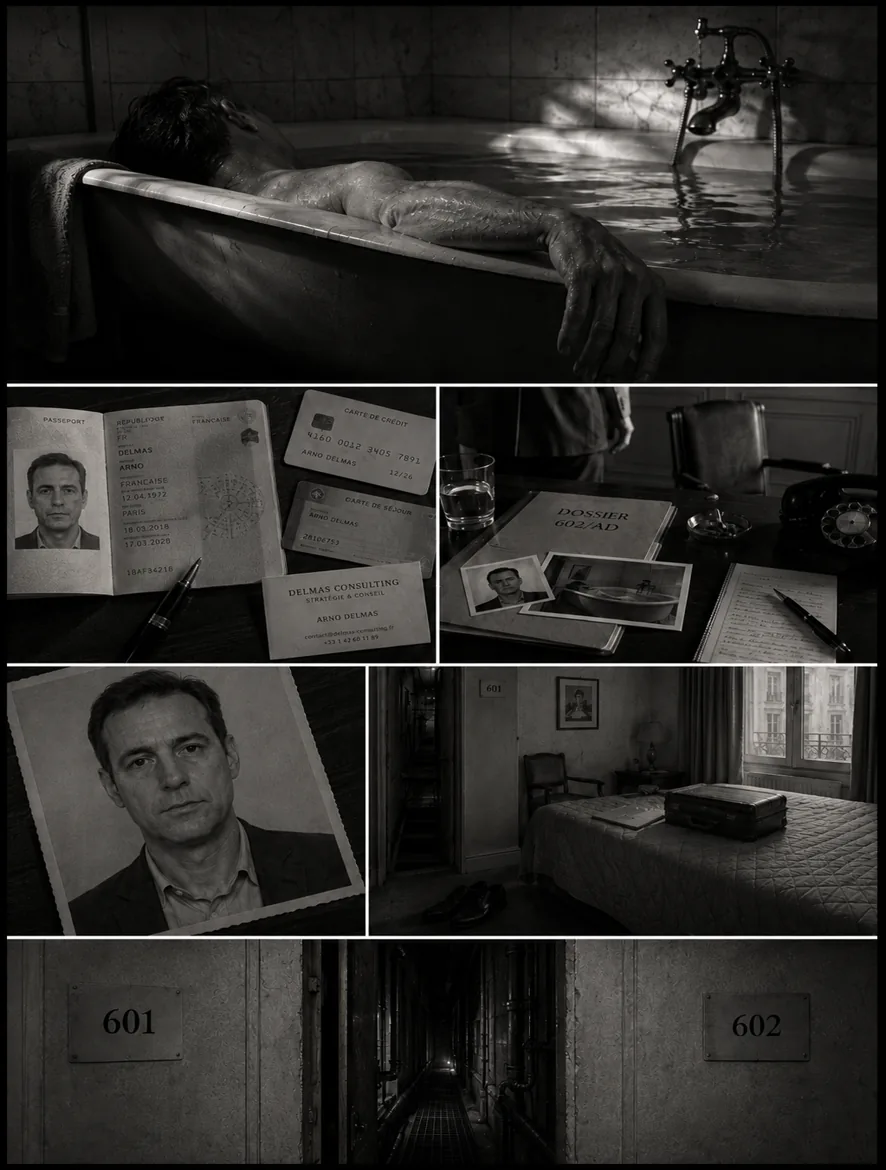
“The passport is valid.”
“Of course.”
“The cards too.”
“Of course.”
“Then what?”
Betty looked at the photograph again.
“It is too exact.”
“That is not a problem.”
“It is.”
The plainclothes man took the photograph and held it towards the light. The lines of the face revealed nothing new. Everything remained unchanged.
“What do you see?”
“Nothing.”
“That is a face.”
“No.”
There was a pause.
“It is an arrangement of features.”
The inspector stopped writing again. The plainclothes man held the photograph longer this time, as though waiting for it to reveal what he had failed to see before.
“You think it is fake?”
“No.”
“Then what?”
“It belongs to the wrong body.”
Silence.
“Based on what?”
Betty kept her eyes on the photograph.
“Because nothing deviates. The suitcase is untouched. The objects have not been used. Room 601 carries no trace of occupancy.”
A brief pause.
“And the body is in 602.”
“Then?” the inspector said.
“Then the identity is standing where the person never was. And the body is lying where it never belonged.”
“No.”
“What do you mean, no?”
“Objects that look like his.”
“That amounts to the same thing.”
“No.”
Betty glanced towards the corridor, as though checking that the boundary was still where she had left it.
“Nothing in 601 was used. There is only a simulation of occupancy.”
“And the body in 602.”
“The body never used 601.”
A pause. That was the key.
For the first time, the plainclothes man gave a slight nod — not agreement, but acknowledgement that the line of inquiry had shifted.
“If he didn’t use the room, where was he?”
“Somewhere he wasn’t supposed to be.”
“And here?”
“Here, he was placed.”
The silence held.
The inspector did not write down her last sentence.
“Then we have a problem.”
“You had one before,” Betty said.
The plainclothes man put the photograph down on the table.
“This is the wrong identity.”
“Yes.”
“Deliberately?”
“Yes.”
“Why?”
Betty hesitated.
“Because the body isn’t what matters.”
“What does?”
“What it carried.”
That was when they understood that the question was no longer who the man was, but what had travelled with him.
At the Passage Hotel, identity did not prove presence. It concealed absence.
The body between 601 and 602 had a name, but no place.
18 — Position
No one disappears in a hotel. That was the basic premise.
Guests arrive, check in and move through a space designed to register their passage: key cards, cameras, staff. Everything is connected; everything leaves a trace.
So disappearance itself was impossible. What was possible was passage that had gone unrecorded.
“If that isn’t him,” the inspector said, “then where is he?”
The question was wrong. Betty looked at the table.
“It isn’t a question of where he is. It’s whether he was ever here.”
The silence was shorter this time. The plainclothes man shifted slightly.
“He was checked in.”
“That isn’t the same thing.”
“His card was used.”
“A card proves access, not occupancy.”
“What does?”
Betty looked up.
“Occupancy.”
The word did not belong in a police report, but it remained between them.
“Explain,” the thin inspector said.
“There is no evidence that anyone stayed in 601. Everything has been arranged to suggest a stay.”
“We’ve heard that already.”
“You didn’t understand it.”
The plainclothes man stood.
“Upstairs.”
It was not a suggestion.
The sixth-floor corridor had been closed to guests without signs, tape or warnings. Only the rhythm had changed. People moved through it more quickly, as though the corridor itself discouraged lingering.
They entered 601.
Betty looked at the suitcase, the cosmetics bag, the curtains, the armchair. Everything was in place — too perfectly in place.
“What are we looking for?”
“Evidence of occupancy.”
“You’ve already said there isn’t any.”
“That’s why we’re looking.”
She went to the suitcase. It was open but untouched. The clothes inside were arranged without the disorder produced by movement — no haste, no choice, no moment when someone searches for something and fails to put it back exactly where it was.
“This isn’t the suitcase of someone staying in a hotel.”
“Maybe he was meticulous.”
“Meticulousness has a pattern. This doesn’t.”
She opened the cosmetics bag. Lipstick, powder, mascara. Everything where it should be.
“This is a picture.”
“Of what?”
“Of a hotel stay.”
The plainclothes man came closer.
“You’re saying he wasn’t here?”
“I’m saying he wasn’t here as a guest.”
“Then as what?”
“As part of the setup.”
The answer did not close the question. It shifted it.
Betty looked towards the connecting door.
“There.”
They crossed into 602.
The room was still empty, but its emptiness no longer looked the same. Once you know what you are looking for, space begins to answer.
She walked to the centre and stopped.
“Here.”
“Based on what?”
“On the fact that he left nothing.”
“That isn’t evidence.”
“It is. Occupancy always leaves a trace. If there is none, someone has removed the consequences.”
The plainclothes man looked at the floor, then the walls, then the ceiling.
“Hidden?”
“No.”
“Then where?”
“In transit.”
There was a pause.
“What transit?”
Betty looked at the door between the rooms.
“Through a passage that doesn’t exist.”
The question changed. They were no longer asking where he had been, but how he had moved.
The plainclothes man opened the connecting door and stood between the rooms, looking from one to the other: the same space, two different uses.
“If he was here, where is he now?”
Then he stopped and summed it up.
“So we have one man who was never here, another who was here but is gone, and finally a body that belongs to neither.”
For the first time, someone else had described it correctly.
19 — Control
There was no official order. The hotel simply tightened around them.
The manager did not change the schedule; he changed the way people looked. The staff continued doing the same work, but lingering disappeared and questions died before they were asked.
Betty noticed it before she could explain it.
On the sixth floor, doors closed faster than before, not because of their mechanisms but because something in the atmosphere no longer allowed them to remain open longer than necessary.
Her phone vibrated. Don’t touch anything. Justine. Betty looked up.
The plainclothes man was already at the far end of the corridor. He was not watching her. He was watching the door to 602.
She approached. The door stood slightly ajar. He remained on the threshold.
“You’ve understood, mademoiselle.”
Betty said nothing.
“Too late.”
The silence did not last.
“We’re looking for different things.”
“Yes. You’re looking for where it was. I’m looking for where it will be.”
She looked at him.
“It already is.”
For a moment he did not move.
“Then you know.”
“I know.”
There was no longer any distance between what she saw and what followed from it.
“Some things are better found than returned,” he said quietly.
“For whom?”
For the first time, he did not look like a policeman.
He smiled slightly, and did not answer. Then he walked away. Betty remained outside 602.
20 — Retention
The examination of the body did not take place in hospital. Not immediately. First came the question of whether the matter could still be contained within the hotel: a doctor brought in, doors closed, as few people as possible and as much control as possible.
Everything in the bathroom of 602 that did not belong to the body had been removed. Nothing distracted the eye.
Betty was not supposed to be there, but she was. She stood against the wall, out of the way, where she could see everything.
The doctor worked efficiently, his movements brief and exact. Gloves, bag, instruments that made almost no sound. The plainclothes man stood behind him and the inspector beside the door, both watching without needing to move.
“No external injuries,” the doctor said, more to himself than to anyone else.
It explained nothing.
He lifted the eyelids, examined the neck and hands, then tested the body with the impersonal movements of someone for whom death had become physical information.
Betty watched the position of the arms. They lay too neatly alongside the body, without the small asymmetries left by an actual fall.
“Moved,” she said quietly.
No one answered. The sentence did not require an answer.
The doctor signalled for the body to be turned. The movement was brief. The back was clean: no abrasions, no marks from being dragged.
“He didn’t come through the corridor,” the inspector said, more conclusion than question.
“Not necessarily,” the doctor replied.
“Yes, necessarily,” Betty said without raising her voice.
They looked at her.
“The cameras cover everything.”
The doctor returned to the hands and fingers.
“Clean nails. No material.”
“There is.”
She came closer without touching the body and pointed.
Along the inside of the palm, at the base of the thumb, ran a faint line — less a stain than the residue of pressure.
The doctor leaned closer.
“Plaster.”
“Or stone,” Betty said.
“He was holding something.”
It was no longer a detail. It was a direction.
The plainclothes man looked at the inspector. Nothing needed to be said. For the first time, the body itself carried a trace.
The doctor examined the mouth, opened it carefully and stopped.
“Here.”
The inspector came closer. Betty could see from where she stood: a slight abrasion on the inside of the lip, as though something hard had struck it.
“Swallowed something?”
“No.”
The doctor took a pair of tweezers and removed a tiny metal fragment, barely visible. He placed it on a piece of gauze without comment.
Betty looked at it. She knew what it came from.
“That isn’t accidental.”
“Nothing is,” the plainclothes man said.
The doctor closed his bag.
“I can’t determine the cause of death here, but it wasn’t natural.”
The body was no longer unknown. It had entered procedure.
The plainclothes man picked up the gauze with the fragment and held it carefully, as though moving it before understanding it might alter its meaning.
“If he was holding something, and part of it ended up in his mouth…”
He did not finish. He did not need to.
Betty looked at the dead man’s hands again. They were still too composed, as though everything that mattered had happened before the body arrived.
“He didn’t die here.”
“We know.”
“No.”
She looked at the inspector.
“He was never here.”
This time, the silence remained.
The plainclothes man looked from the metal fragment to Betty.
“Then we have three places: where he was, where he died, and where he was left.”
Betty looked towards the wall. If the body had never been here, it could not have been far away. It had been somewhere movement went unrecorded.
“And none of them is this room.”
Betty nodded.
21 — Passage
The body was absent from the hotel records, but that was no longer the problem.
At the Passage Hotel, everything that entered had to be registered: name, document, key card. Even those who did not want to be seen left a trace.
There was none here. That did not mean the body did not exist. It meant it had not entered as a guest.
What was missing was the route.
Betty stood on the threshold of 602. She did not approach immediately and did not look at the face. She looked at the way the body lay.
It had not truly been positioned. It had been left.
The difference was not in the posture itself, but in the relationship between the body and the room, as though the space had never fully accepted it.
She moved closer. On the skin was an imprint — not a wound, not an injury, but the residue of something held tightly and then released.
Something was missing. Not obvious at first.
“You know what we found?”
The plainclothes man was behind her.
“A body.”
“No. Someone who doesn’t exist in the register.”
Betty kept looking at the hand.
“If the body didn’t enter as a guest,” he continued, “then no one left as a guest either.”
Now she turned.
“Then who did?”
“Someone who never entered.”
Betty looked back at the body, then at the door between the rooms. Her gaze returned to the hand — not to what was there, but to what was missing.
She was looking for movement.
22 — Trace
The body was removed from 602. Room 601 remained unchanged.
One room contained no evidence of a stay. The other, no evidence of an arrival.
Betty entered 601 without delay and went directly to the table, as though continuing a movement she had already begun. The cosmetics bag was closed now; yesterday it had not been. Inside, the mascara remained sealed and untouched.
Everything was correctly placed. Nothing was true.
Someone had restored only what was needed to preserve the appearance of order.
At reception, the record was complete: name, signature, room number.
Only the stay itself was missing.
Downstairs, the police were already moving through the hotel as though it belonged to them. Reception continued without interruption, voices low, movement even.
The plainclothes man stood against the wall, watching.
“The room has been cleaned.”
The inspector looked towards the corridor leading to the service lifts before answering.
“Too soon.”
23 — Direction
The meeting had not been arranged, but it had become inevitable.
The management office resembled the rest of the hotel: designed not to retain the presence of those who passed through it.
The inspector was already there. The plainclothes man was late. The director stood by the window, the manager beside the table, without notes. No one spoke.
Justine remained standing, as though defining the limits of the meeting by refusing to settle into it. Betty took her place near the door, not for protection, but because from there she could see both the exit and everything that remained inside.
“This isn’t an isolated case,” Justine said.
“Nothing here is isolated.”
“The object from Nice.”
Betty held her gaze for a moment.
“It isn’t in the hotel.”
“It never was,” Justine said.
The silence required no explanation.
“You have someone moving through the system without remaining inside it,” Justine said firmly.
“No,” Betty replied. “We have someone who is part of the system.”
Justine looked up from her notes for the first time.
The door opened without a knock. The plainclothes man entered and took over the conversation.
“We have a problem.”
Justine did not look at him.
“You had one already.”
He hesitated, as though deciding whether to continue.
“A kitchen worker.”
Betty knew immediately whom he meant.
“He isn’t on the staff register.”
Betty and Justine exchanged a look. Not agreement, but recognition.
They did not work in the same way.
They were looking for the same thing.
“He isn’t what you need to catch,” Betty said.
Justine held her gaze.
“I’m not trying to catch him. I’m trying to catch what he moves through.”
The manager said nothing. Neither did the inspector. The conversation went no further.
24 — Closing In
What passes through a system does not always leave a trace.
But it changes the arrangement of what it passes through.
The kitchen worked without interruption, its movements rehearsed until they became almost invisible: hands lifting, lowering, carrying; bodies passing without touching; voices lasting no longer than necessary.
A closed circuit. Betty was not looking for a person. She was watching the flow.
A kitchen worker came through the rear door carrying an empty crate. He emerged later with the same crate, now closed.
The crate was the same. The route was not.
Somewhere between the two points, part of its journey had disappeared.
Betty watched the space between the door and the worktable. Something moved through it, not as an object but as a trajectory.
Flobjan stood against the wall, holding shears that did not belong in a kitchen. He did not look at Betty, but knew she was there.
For once, she was not watching his hands.
She watched his mouth when he spoke.
“You’re looking for the wrong thing.”
“I’m not looking. I’m following.”
He nodded.
“Then you won’t see it.”
“I don’t need to see it. I need it to leave a consequence.”
The worker passed along the same route again.
The crate was lighter now. Nothing visible revealed the difference, but the way he carried it did.
Police moved through the hotel without sudden gestures, fitting themselves into its rhythm while altering it. Every passage now had a boundary.
The worker reached the point where the service corridor narrowed and paused just long enough to make sure no one was there.
Betty entered from the opposite end.
“He’s gone.”
“Where?” Flobjan asked.
“Not outside.”
The worker moved towards a narrow service opening behind the wall.
One quick movement of his hand — and the motion vanished before it could be held.

